


instant extended auto warranty decisions made simple

You want quick coverage without getting boxed into a bad contract. Instant feels convenient, but value lives in the details you verify before you tap Buy.

What instant really means

Instant usually means digital quotes, fast binding, and a contract in your inbox within minutes. Coverage may still have a short waiting period or mileage buffer. Some providers start protection immediately if you pass a light inspection or share service records. Know which version you're getting.

Evaluate before you click

  • Coverage tier: Powertrain, stated-component, or exclusionary (best, most expensive). Ask what's not covered.
  • Your model's weak spots: Compare known failures for your vehicle with the plan's covered components.
  • Limits and caps: per-claim, per-component, and total aggregate. Tiny caps erase big promises.
  • Deductible type: per visit vs per repair item. Per visit is simpler if multiple parts fail.
  • Waiting rules: days and miles. Are pre-existing conditions excluded?
  • Repair choice: any licensed shop or a network only. Confirm labor rate caps.
  • Claims flow: pre-authorization steps, inspection triggers, and whether the provider pays the shop directly.
  • Extras: roadside, rental, trip interruption. Useful, but verify dollar amounts and days.
  • Portability: transfer to next owner, and cancellation terms with refund calculation.
  • Price reality: monthly plans may include finance fees. Ask for pay-in-full and see the delta.
  • Company health: years in business, claims hours, and real customer service access.

Compare plan styles

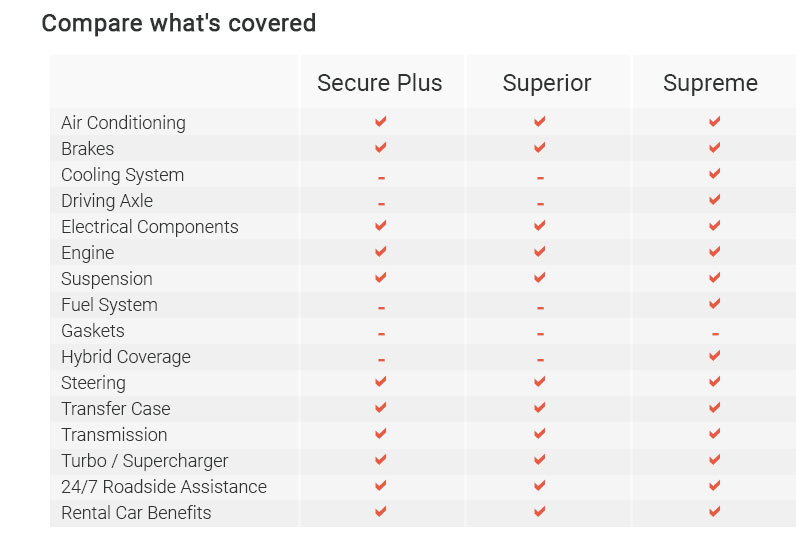
Powertrain

Engine, transmission, drive components. Cheapest, but you'll pay out of pocket for tech and electrical gremlins. Best if you only fear catastrophic failures.

Stated-component

A list of covered parts. If it's not listed, it isn't covered. Expect gaps around sensors, wiring, and trim. Read line by line.

Exclusionary

Everything is covered except what's excluded. Clearer for you, pricier up front, often the best fit for complex modern vehicles.

Calculate true value

  1. Estimate likely repairs over your ownership horizon and compare to premiums plus deductible.
  2. Check coverage overlap with factory warranty and recalls so you don't double-pay.
  3. Quantify convenience: roadside, rentals, trip interruption can save real time and stress.
  4. Consider inflation: parts and labor climb; a fixed plan can hedge rising costs.

Pause - what matters most to you: lowest cost, broadest coverage, or the smoothest claim?

A quick, real-world moment

It's a wet Tuesday night. Your starter clicks, then silence in a grocery lot. You open the provider's app, request roadside, and they dispatch a tow to your preferred shop. The advisor calls the claims number on your card, gets pre-approval, and the company pays the shop directly. You pay a $100 deductible. Back on the road by noon tomorrow.

Red flags to watch

  • Proof-of-maintenance demands without clear examples of acceptable receipts.
  • Overheating and coolant loss broadly excluded, including consequential engine damage.
  • Diagnostics and tear-down not covered if the claim is denied.
  • "Betterment" charges when upgraded parts are installed.
  • Commercial or rideshare use excluded unless explicitly added.
  • Low labor-rate caps that no shop will accept.

Smart selection flow

  1. Gather VIN, mileage, service records, and known issues.
  2. Pull two to three instant quotes for the same terms to compare apples to apples.
  3. Download sample contracts and highlight exclusions, limits, and claims steps.
  4. Call the claims line with a hypothetical failure and note the process times.
  5. Confirm with your preferred shop that they accept the plan and the labor rate.
  6. Pick a deductible that fits your cash cushion; higher often lowers premium.
  7. Confirm start date, waiting period, and cancellation math in writing before paying.
  8. Save the contract, roadside number, and a one-page claims checklist in your glovebox.

Ways to lower cost without losing value

  • Choose exclusionary with a higher deductible instead of broad mid-tier with gaps.
  • Remove coverage for features your car doesn't have.
  • Pay in full to avoid installment fees.
  • Shorter term that matches your planned ownership mileage.
  • Ask about telematics or multi-vehicle discounts.
  • Check credit union or employer group pricing.

After purchase: set yourself up

  • Log maintenance per the owner's manual; keep dated receipts.
  • Note the exact claims phone number and required info (VIN, mileage, shop contact).
  • Use shops that call for pre-authorization before repairs begin.
  • Track warning lights early; small issues become big exclusions if ignored.

If skipping is smarter

Keep your money if you still have strong factory coverage, plan to sell soon, maintain a solid emergency fund, or can self-insure likely repairs. Protection is optional; confidence in your budget is not.

Final take

Instant can be great for speed, but your win comes from careful evaluation and a plan that fits your budget, your car, and how long you'll keep it. Clarity first, signature second.

https://www.fairwarranty.com/
A Vehicle Service Contract (VSC), commonly called an auto warranty or an extended car warranty, is not a warranty.

https://instantautofinance.net/warranty/
At no additional cost to you Instant Auto Finance, Inc. provides you with a 12 Month or 12,000 Mile (whichever occur first) Limited Warranty. We pay 50% of the ...

https://www.noblequote.com/learning-center/general-information-and-education/how-to-get-an-extended-car-warranty-quote-fast-service-zero-hassle-total-peace-of-mind-with-noblequote
... vehicle information, selecting a coverage plan, and receiving an instant quote. ... extended car warranty, but it is not a warranty. A VSC does ...


atwratnwm
4.9 stars -1975 reviews